Thursday, August 31, 2017

The Coming Gold “Break Out”

Gold has conducted what some are calling a “stealth rally” over the past month.

After bottoming at $1,206 per ounce on July 10, gold is at $1,286 this morning, a healthy 6.5% gain in just over one month.

The has been welcome relief for gold investors after a series of “flash crashes” on June 14, June 26 and July 3 contributed to a gold drawdown from $1,294 per ounce to $1,206 per ounce between June 6 and July 10. At that point it looked as though gold might fall through technical resistance and tumble to the $1,150 per ounce range.

But the new rally restored the upward momentum in gold we have seen since the post-election low on Dec. 15, 2016. Gold seems poised to resume its march to $1,300 after the paper gold bear raids of late June.

The physical fundamentals are stronger than ever for gold. Russia and China continue to be huge buyers. China bans export of its 450 tons per year of physical production.

Gold refiners are working around the clock and cannot meet demand. Gold refiners are also having difficulty finding gold to refine as mining output, official bullion sales and scrap inflows all remain weak.

Private bullion continues to migrate from bank vaults at UBS and Credit Suisse into nonbank vaults at Brinks and Loomis, thus reducing the floating supply available for bank unallocated gold sales.

In other words, the physical supply situation is tight as a drum.

The problem, of course, is unlimited selling in “paper” gold markets such as the Comex gold futures and similar instruments.

One of the flash crashes was precipitated by the instantaneous sale of gold futures contracts equal in underlying amount to 60 tons of physical gold. The largest bullion banks in the world could not source 60 tons of physical gold if they had months to do it.

There’s just not that much gold available. But in the paper gold market, there’s no limit on size, so anything goes.

There’s no sense complaining about this situation. It is what it is, and it won’t be broken up anytime soon. The main source of comfort is knowing that fundamentals always win in the long run even if there are temporary reversals. What you need to do is be patient, stay the course and buy strategically when the drawdowns emerge.

Where do we go from here?

August and September are traditionally strong seasonal periods for gold. This is partly due to proximity to the wedding and gift season in India, when strong buying prevails.

Yet there’s more to the gold demand story this year.

Deteriorating relations between the U.S. and Russia will only accelerate Russia’s efforts to diversify its reserves away from dollar assets (which can be frozen by the U.S. on a moment’s notice) to gold assets, which are immune to asset freezes and seizures.

The countdown to war with North Korea has begun. A U.S. attack on the North Korean nuclear and missile weapons programs is likely by mid-2018. The stock market may not have noticed, but the gold market has. This is part of the reason for recent gold strength.

Finally, we have to deal with our friends at the Fed. The strong jobs report on Friday, Aug. 4, gave life to the view that the Fed would raise interest rates at least one more time this year. Rate hikes make the dollar stronger and are a head wind for the dollar price of gold.

But the Fed will not hike rates again this year. Once the market wakes up to the reality of a prolonged “pause” by the Fed, they will conclude correctly that the Fed is once again attempting to ease by “forward guidance.” This relative ease will keep the dollar on its downward trend and be a boost to the dollar price of gold.

The Fed will not hike rates regardless of the strong jobs report. The reason is that strong job growth was “mission accomplished” for the Fed over a year ago. Jobs are not the determining factor in Fed rate decisions today. The determining factor is disinflation.

The Fed’s main inflation metric has been moving in the wrong direction since January. The readings on the core PCE deflator year over year (the Fed’s preferred metric) were:

January 1.9%
February 1.9%
March 1.6%
April 1.6%
May 1.5%
June 1.5%

The July data will not be available until early September.

The Fed’s target rate for this metric is 2%. It will take a sustained increase over several months for the Fed to conclude that inflation is back on track to meet the Fed’s goal.

There’s no chance of this happening before the Fed’s September meeting. It’s unlikely to happen before December, because of weakness in auto sales, retail sales, discretionary spending and consumer credit.

A weak dollar is the Fed’s only chance for more inflation. The way to get a weak dollar is to delay rate hikes indefinitely, and that’s what the Fed will do.

And a weak dollar means a higher dollar price for gold.

Current levels look like the last stop before $1,300 per ounce gold. After that, a price surge is likely as buyers jump on the bandwagon, and then it’s up, up and away.

There’s an old saying that “a picture is worth a thousand words.” This chart is a good example of why that’s true:
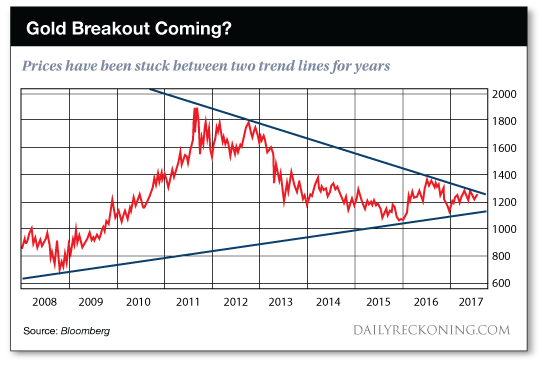

Gold analyst Eddie Van Der Walt produced this 10-year chart for the dollar price of gold showing that gold prices have been converging into a narrow tunnel between two price trends — one trending higher and one lower — for the past six years.

This pattern has been especially pronounced since 2015. You can see gold has traded up and down in a range between $1,050 and $1,380 per ounce. The upper trend line and the lower trend line converge into a funnel.

Since gold will not remain in that funnel much longer (because it converges to a fixed price) gold will likely “break out” to the upside or downside, typically with a huge move that disrupts the pattern.

At the extreme, this could imply a gold price on its way to $1,800 or $800 per ounce. Which will it be?

The evidence overwhelmingly supports the thesis that gold will break out to the upside. Central banks are determined to get more inflation and will flip to easing policies if that’s what it takes.

Geopolitical risks are piling up from North Korea, to Syria, to the South China Sea and beyond.

The failure of the Trump agenda has put the stock market on edge and a substantial market correction may be in the cards.

Acute shortages of physical gold have set the stage for a delivery failure or a short squeeze.

Any one of these developments is enough to send gold soaring in response to a panic or as part of a flight to quality. The only force that could take gold lower is deflation, and that is the one thing central banks will never allow. The above chart is one of the most powerful bullish indicators I’ve ever seen.

Get ready for an explosion to the upside in the dollar price of gold. Make sure you have your physical gold and gold mining shares before the breakout begins.

- Source, James Rickards

Monday, August 28, 2017

How Badly Does China Want Gold?


In best-selling author Jim Rickards’ latest book, the New Case For Gold, he brings up one of the most common criticisms of a new gold standard – that there is not enough gold to support it. 

Rickards makes the argument that it would work at a certain price level. In his interview with Kitco News, Rickards also discusses China and gold buying. He suggests that China is suppressing the gold price through the COMEX market in order to build-up more physical supplies. 

Once they have a sufficient supply, equal to the United States, they will no longer care what the metal's price is and it will likely skyrocket, he explains.


Friday, August 25, 2017

Bitcoin No Threat To U.S. Dollar, Gold - Jim Rickards


The cryptocurrency craze continues with the leading virtual currency — Bitcoin — trading near record highs. But, to bestselling author and currency expert Jim Rickards, the new age currency may be in a bubble. 

Delving into the theory of valuation, the Currency Wars author said that even if investors seem to be expressing a liquidity preference for Bitcoin over the dollar, it doesn’t necessarily mean they are losing confidence in the greenback. ‘If you were losing confidence in the dollar than gold would be going up and it’s not, so it looks like a bubble,’ he told Kitco News. 

He added that investors should not worry that virtual currencies take over the U.S. dollar’s reserve currency status any time soon because the market is just too small. Another facet that investors may be ignoring, Rickards continued, is that investors racking up substantial gains from crypto investments might not be properly filing their taxes. “The IRS could subpoena one of these [cryptocurrency] exchanges and freeze up all the bitcoin,’ he said. ‘The IRS did this with Americans with Swiss bank accounts, they’ll do it with bitcoin.’

- Source, Kitco News

Tuesday, August 22, 2017

Why Elites Are Winning the War on Cash

Visa recently unveiled its own offensive in the war on cash. Visa is offering certain merchants a $10,000 reward if they refuse to accept cash in the future.

Not surprisingly, Visa’s competitor is also part of the war on cash. Mastercard is increasing its efforts to encourage merchants to refuse cash. Here’s Bloomberg, quoting the CEO of Mastercard:

“Mastercard Chief Executive Officer Ajay Banga has been one of the most ardent supporters of ditching paper currency in the U.S. The 57-year-old first declared his war on cash in 2010.”

These private efforts by Visa and MasterCard exist side by side with official efforts to eliminate or discourage the use of cash coming from governments in India, Australia, Sweden as well as the United States.

These efforts are always portrayed in the most favorable light. Private parties talk about convenience and lower costs. Governments talk about putting pressure on tax cheats, terrorists and criminals.

Governments always use money laundering, drug dealing and terrorism as an excuse to keep tabs on honest citizens and deprive them of the ability to use money alternatives such as physical cash and gold.

But the so-called “cashless society” is just a Trojan horse for a system in which all financial wealth is electronic and represented digitally in the records of a small number of megabanks and asset managers.

Once that is achieved, it will be easy for state power to seize and freeze the wealth, or subject it to constant surveillance, taxation and other forms of digital confiscation.

The war on cash has two main thrusts. The first is to make it difficult to obtain cash in the first place. U.S. banks will report anyone taking more than $3,000 in cash as engaging in a “suspicious activity” using Treasury Form SAR (Suspicious Activity Report).

The second thrust is to eliminate large-denomination banknotes. The U.S. got rid of its $500 note in 1969, and the $100 note has lost 85% of its purchasing power since then. With a little more inflation, the $100 bill will be reduced to chump change.

Last year the European Central Bank announced that they were discontinuing the production of new 500 euro notes. Existing 500 euro notes will still be legal tender, but new ones will not be produced.

This means that over time, the notes will be in short supply and individuals in need of large denominations may actually bid up the price above face value paying, say, 502 euros in smaller bills for a 500 euro note. The 2 euro premium in this example is like a negative interest rate on cash.

The real burden of the war on cash falls on honest citizens who are made vulnerable to wealth confiscation through negative interest rates, loss of privacy, account freezes and limits on cash withdrawals or transfers.

The whole idea of the war on cash is to force savers into digital bank accounts so their money can be taken from them in the form of negative interest rates. An easy solution to this is to go to physical cash.

The war on cash is a global effort being waged on many fronts. My view is that the war on cash is dangerous in terms of lost privacy and the risk of government confiscation of wealth. India provides the most dramatic example.

How would you like to go to bed one night and then wake up the next morning to discover that all bills larger than $5.00 were no longer legal tender? That’s essentially what happened in India not long ago.

The good news is that cash is still a dominant form of payment in many countries including the U.S. The problem is that as digital payments grow and the use of cash diminishes, a “tipping point” is reached where suddenly it makes no sense to continue using cash because of the expense and logistics involved.

Once cash usage shrinks to a certain point, economies of scale are lost and usage can go to zero almost overnight. Remember how music CDs disappeared suddenly once MP3 and streaming formats became popular?

That’s how fast cash can disappear.

Once the war on cash gains that kind of momentum, it will be practically impossible to stop. That’s why I’m always saying that savers and those with a long-term view should get physical gold now while prices are still attractive and while they still can.

Given these potential outcomes, one might expect that citizens would push back against the war on cash.

But in some places, the opposite seems to be happening.

A recent survey revealed that more than a third of Americans and Europeans would have no problem at all giving up cash and going completely digital.

Specifically, the study showed 34% of Europeans and 38% of Americans surveyed would prefer going cashless.

Notably, Germans are the most resistant to going cashless. Almost 80% of transactions in Germany are done in cash, and many Germans never use credit cards.

The German experience with hyperinflation after WWI and additional monetary chaos after WWII certainly plays a part in this resistance to the cashless society.

Incidentally, the German word for debt, schuld, also means guilt.

Other countries, such as Romania and Bulgaria, which have recent experiences with currency and financial crises, also tend to use cash extensively.

Of course, there’s no denying that digital payments are certainly convenient. I use them myself in the form of credit and debit cards, wire transfers, automatic deposits and bill payments.

The surest way to lull someone into complacency is to offer a “convenience” that quickly becomes habit and impossible to do without.

The convenience factor is becoming more prevalent, and consumers are moving from cash to digital payments just as they moved from gold and silver coins to paper money a hundred years ago.

But when the next financial panic comes, those without tangible wealth will be totally at the mercy of banks and governments who will decide exactly how much of your own money you’re allowed to have each day.

Just ask the citizens of Cyprus, Greece and India who have gone through this experience in recent years.

It will come to the U.S. soon enough.

Other dangers arise from the fact that digital money, transferred by credit or debit cards or other electronic payments systems, are completely dependent on the power grid. If the power grid goes out due to storms, accidents, sabotage or cyberattacks, our digital economy will grind to a complete halt.

That’s why it’s a good idea to keep some of your liquidity in paper cash (while you can) and gold or silver coins. The gold and silver coins in particular will be money good in every state of the world.

I hold significant portion of my wealth in nondigital form, including real estate, fine art and precious metals in safe, nonbank storage.

I strongly suggest you do the same.

- Source, The Daily Reckoning via Jim Rickards

Saturday, August 19, 2017

Jim Rickards: Thoughts on the US Economy, Section 232 and the Gold Price


Jim Rickards chats about his latest book, the potential for future interest rate hikes and US President Donald Trump's steel probe. He also shares his advice for investors.

- Source, Investing News

Wednesday, August 16, 2017

Gold prices have nowhere to go but up: Jim Rickards

Gold prices have nowhere to go but up: Jim Rickards from CNBC.

Gold prices stand to benefit as central banks continue targeting higher inflation rates, says Strategic Intelligence's Jim Rickards.

- Source, CNBC

Friday, August 11, 2017

Michael Pento and Jim Rickards on When it All Comes Apart


Join Michael Pento and best selling author & National security expert Jim Rickards as they discuss North Korea, debt the stock markets and when this all unravels .

Rickard's says "What Are You Waiting For, Get Your Gold Before Your Not Going To Get It Anymore".


Thursday, August 3, 2017

James Rickards: Gold Will Start Heading Higher On “Dwindling” Supply

Gold was down after the Fed’s hike, but I expect it to start heading higher again. Too many powerful forces are driving it behind the scenes. Dwindling physical supply is a major one.


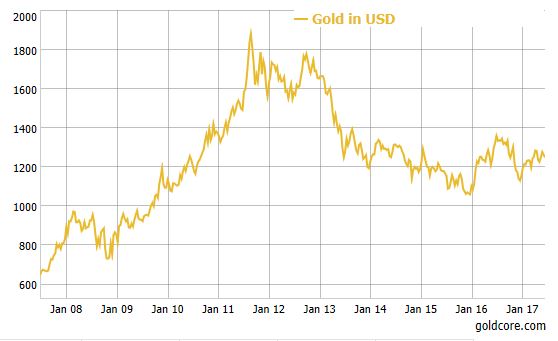
Gold in USD (5 Years)

On a recent visit to Switzerland, I was informed that secure logistics operators could not build new vaults fast enough and were taking over nuclear-bomb proof mountain bunkers from the Swiss Army to handle the demand for private storage.

Geopolitical fear is another. The crises in North Korea, Syria, Iran, the South China Sea, and Venezuela are not getting better. The headlines may fade in any given week, but geopolitical shocks will return when least expected and send gold soaring in a flight to safety.

Fed policy tightening is normally a headwind for gold. But, the last two times the Fed raised rates — December 14, 2016 and March 15, 2017 — gold rallied as if on cue.

Gold is the most forward-looking of any major market. It may be the case that the gold market sees the Fed is tightening into weakness and will eventually over-tighten and cause a recession.

At that point, the Fed will pivot back to easing through forward guidance. That will result in more inflation and a weaker dollar, which is the perfect environment for gold.

In short, all signs point to higher gold prices in the months ahead based on Fed ease, geopolitical tensions, and a weaker dollar.

- Source, Gold Seek

Monday, July 31, 2017

James Rickards: The Fed’s Road Ahead

I’m a big critic of the Fed models, but that’s because they’re obsolete and they don’t record with reality. You need the right ones.

In a typical business cycle, the economy starts from a low base, then gradually business starts expanding, hiring picks up, more people spend money, and businesses expand.

Eventually, industrial capacity is used up, labor markets tighten, resources are stretched. Prices rise, inflation picks up and the Fed comes along and says “Aha! There’s some inflation. We’d better snuff it.”

So it raises rates, usually for a full cycle.

Eventually it has to lower rates when the process goes into reverse. That’s the normal business cycle. It’s what everyone on Wall Street looks at. And historically, they’re right. That process has been happening 40 times since the end of World War II.

The problem is, that’s not what’s happening now. We’re in a new reality.

This is a result of nine years of unconventional monetary policy — QE1, QE2, QE3, Operation Twist and ZIRP. This has never happened before. It was a giant science experiment by Ben Bernanke.

And that’s the key…

You have to have models that accord to the new reality, not the old. Wall Street is still going by the old model.

The new reality is that the Fed basically missed a whole cycle. They should have raised in 2009, 2010 and 2011. Economic growth was not powerful. In fact it was fairly weak. But it was still the early stage of a growth cycle. If they had raised rates, many would have grumbled, the stock market would have hit a speed bump, but it wouldn’t have been the end of the world.

We’d just had a crash. But by the end of 2009, the panic was basically over. There was no liquidity crisis. There was plenty of money in the system. There was no shortage of money and interest rates were zero. They could have tried an initial 25-point rise but they didn’t.

This isn’t Monday morning quarterbacking, either. I was on CNBC’s “Squawk Box” in August ’09. The host turned to me and asked, “Jim, what do you think the Fed should do?”

My response was, “They should raise rates a little bit, just to say they were going to get back to normal.” Of course, that never happened.

Now we’re at a very delicate point, because the Fed missed the opportunity to raise rates five years ago. They’re trying to play catch-up, and yesterday’s was the third rate hike in six months.

Economic research shows that in a recession, they have to cut interest rates 300 basis points or more, or 3%, to lift the economy out of recession. I’m not saying we are in a recession now, although we’re probably close.

But if a recession arrives a few months or even a year from now, how is the Fed going to cut rates 3% if they’re only at 1.25%?

The answer is, they can’t.

So the Fed’s desperately trying to raise interest rates up to 300 basis points, or 3%, before the next recession, so they have room to start cutting again. In other words, they are raising rates so they can cut them.

And that’s what Wall Street doesn’t understand. It’s still operating from its old assumptions about the business cycle.

Wall Street thinks the Fed’s raising rates because official unemployment is low and the economy’s strengthening. But as I just explained, that’s not the reason at all. The reality’s quite different.

The Fed is hiking rates not because economy is strong, but because it’s desperate to catch up with the fact that Bernanke skipped a whole cycle in 2009, 2010 and 2011. So as usual, Wall Street is reading the signals exactly backwards.

The Fed’s actually tightening into weakness.

So now what?

After yesterday’s hike, the Fed still has a long way to get to 3%. That means seven more hikes of 25 basis points each, every other meeting, or four hikes a year. That means the mission won’t be accomplished until June 2019.

What would cause the Fed to back off? Any of three conditions…

Number one is a market meltdown. If the stock market sells off 5%, which would be over 1,000 points on the Dow, that would not be enough to throw them off. But if it goes down 15%, that’s a different story. Ben Bernanke actually told me that not long ago.

Now, if the stock market falls 10%, the Fed will pause. It won’t raise. But it won’t cut either at that point.

Now, markets are complacent right now and are not expecting any sudden moves to the downside. But it’s when markets are most complacent that sudden drops are most likely. August 2015 and January 2016 are good examples. Another drop could be right around the corner.

The second condition is if job creation dries up. Now, job creation does not have to be 200,000 jobs a month, or even 150,000 jobs a month. Their baseline is around 75,000, which is a very low base. If you see jobs go below 75,000, the Fed may pause.

The third condition is disinflation. Now, I’m not talking about outright deflation. I mean inflation falling substantially short of the Fed’s target under a metric called PCE, or the Personal Consumption Expenditure Price Deflator Core.

You may be skeptical of how the Fed measures inflation, and rightly so. But you have to look at what the Fed looks at to know what they’re up to, right or wrong. And they look at the PCE, year over year.

The Fed wants 2% inflation. Lately it’s been getting close. But if that figure drops to, say, 1.4, that’s another reason to hit the pause button. That seems unlikely at this point.

Unless any of these three conditions materialize, the Fed intends to raise rates four times a year, every other meeting, until the middle of 2019. If any one of those three things happen along the way, the Fed will probably hit the pause button. If all three happen, it will definitely pause.

Gold is down today after yesterday’s hike, but I expect it to start heading higher again. Too many powerful forces are driving it behind the scenes. Dwindling physical supply is a major one.

On a recent visit to Switzerland, I was informed that secure logistics operators could not build new vaults fast enough and were taking over nuclear-bomb proof mountain bunkers from the Swiss Army to handle the demand for private storage.

Geopolitical fear is another. The crises in North Korea, Syria, Iran, the South China Sea, and Venezuela are not getting better. The headlines may fade in any given week, but geopolitical shocks will return when least expected and send gold soaring in a flight to safety.

Fed policy tightening is normally a headwind for gold. But, the last two times the Fed raised rates — December 14, 2016 and March 15, 2017 — gold rallied as if on cue.

Gold is the most forward-looking of any major market. It may be the case that the gold market sees the Fed is tightening into weakness and will eventually over-tighten and cause a recession.

At that point, the Fed will pivot back to easing through forward guidance. That will result in more inflation and a weaker dollar, which is the perfect environment for gold.

In short, all signs point to higher gold prices in the months ahead based on Fed ease, geopolitical tensions, and a weaker dollar.

- Source, James Rickards via the Daily Reckoning

Thursday, July 27, 2017

Why the Fed Will Fail Once Again

John Maynard Keynes once wrote, “Practical men who believe themselves to be quite exempt from any intellectual influence, are usually the slaves of some defunct economist.”

Truer words were never spoken, although if you updated Keynes today, the quote would begin with “practical women” to take account of Fed Chair Janet Yellen. The “defunct economist” in question would be William Phillips, inventor of the Phillips curve, who died in 1975.

In its simplest form, the Phillips curve is a single-equation model that describes an inverse relationship between inflation and unemployment. As unemployment declines, inflation goes up, and vice versa. The equation was put forward in an academic paper in 1958 and was considered a useful guide to policy in the 1960s and early 1970s.

By the mid-1970s the Phillips curve broke down. The U.S. had high unemployment and high inflation at the same time, something called “stagflation.” Milton Friedman advanced the idea that the Phillips curve could only be valid in the short run because inflation in the long run is always determined by money supply.

Economists began to tweak the original equation to add factors — some of which were not empirical at all but model-based. It became a mess of models based on models, none of which bore any particular relationship to reality. By the early 1980s, the Phillips curve was no longer taken seriously even by academics and seemed buried once and for all. RIP.

But like a zombie from The Walking Dead, the Phillips curve is baaaack!

And the person who has done the most to revive it is none other than Janet Yellen, the 70-year-old liberal labor economist who also happens to be chair of the Federal Reserve.

Unemployment in the U.S. today is 4.3%, the lowest rate since the early 2000s. Yellen assumes this must result in inflation as scarce labor demands a pay raise and the economy pushes up against the limits of real growth. Yellen also agrees with Friedman that monetary policy works with a lag.

If you believe that inflation is coming soon and that policy works with a lag, you better raise interest rates now to keep the inflation from getting out of control. That’s exactly what Yellen and her colleagues have been doing.

Meanwhile, back in the real world, all signs point not to inflation but to deflation. Oil prices are declining, intermediate-term interest rates are falling, labor force participation is falling, demographics favor saving over spending and logistics and supply-chain giants like Wal-Mart and Amazon are relentlessly squashing price increases wherever they appear.

Even traditional high-price sectors like college tuition and health care have been cooling off lately.

Yellen and a small group of Fed insiders, including Bill Dudley and Stan Fischer, are keeping up the drumbeat for more rate hikes later this year. Opposition to more rate hikes among Fed officials is growing, including from Neel Kashkari, Lael Brainard and Charles Evans.

This intellectual tug of war is coming to a head.

First, bonds are rallying because the bond market expects a recession or slowdown due to unnecessary tightening by the Fed. Which brings me to Bill Gross…

Practically every investor has heard of Bill Gross. For decades he was the head of PIMCO and ran the world’s largest bond fund. His specialty was U.S. Treasury debt..

PIMCO was always a “bigfoot” in the bond marketplace. In the 1980s and 1990s, I was chief credit officer at a major U.S. Treasury bond dealer, one of the so-called “primary dealers” who get to trade directly with the Federal Reserve open market operations trading desk.

PIMCO had dedicated lines and a dedicated sales team at our firm. When they called to buy or sell, it would move markets. Every primary dealer wanted to be the first firm to get the call.

Gross is famous for outperforming major bond indices by a wide margin. The way to do that is market timing. If you sell bonds just ahead of a rising rate environment, and buy them back when the Fed is ready to reverse course you not only capture most of the coupon and par value at maturity, you can book huge capital gains besides.

Now Gross has issued one of his most stark warnings yet. He says that market risk levels today are higher than any time since just before the 2008 panic. We all know what happened then. Gross says it could happen again, and soon.

No one reads the market better than Bill Gross. So, when he issues a warning, investors are wise to pay attention.

The stock market is giving a different signal. Stocks are rallying because markets interpret Fed rate hikes as a signal that the economy is getting stronger.

Both markets cannot be right. Either stocks or bonds will crash in the weeks ahead.

Gold is watching and waiting, moving down on deflation fears and then up again on the view that the Fed will have to reverse course once the economy cools down.

My models show that bonds, Bill Gross and gold have it right and that stocks are heading for a fall.

The stock market correction won’t come right away, because the Fed is still in a mode to talk up rate hikes and strong growth and to dismiss disinflation as “transitory.”

Yet even Janet Yellen can’t ignore reality forever. The Atlanta Fed GDP growth forecast for the second quarter has gone from 4.3% on May 1, to 3.4% on June 2, to 2.9% on June 15.

Today it released its latest growth forecast, which remains unchanged from its June 15 reading — 2.9%.

Something is slowing down the economy, and that something is Fed rate hikes.

By August, even the Fed will get the message. But by then it may be too late. If Q2 growth comes in at 2.5% combined with Q1 growth of 1.2%, that would put 2017 first-half growth at about 1.85%.

That’s even weaker than the historically weak 2.0% growth of the current expansion since June 2009. This is not the stuff of which inflation is made.

The Fed’s bungling should come as no surprise.

The Federal Reserve has done almost nothing right for at least the past twenty years, if not longer. The Fed organized a bailout of Long-Term Capital Management in 1998, which arguably should have been allowed to fail (with a Lehman failure right behind) as a cautionary tale for Wall Street.

Instead the bubbles got bigger, leading to a more catastrophic collapse in 2008. Greenspan kept rates too low for too long from 2002-2006, which led to the housing bubble and collapse.

Bernanke conducted an “experiment” (his word) in quantitative easing from 2008-2013, which did not produce expected growth, but did produce new asset bubbles in stocks and emerging markets debt.

Yellen is now raising rates in a weak economy, which should produce the same recessionary reaction as 1937, the last time the Fed raised into weakness.

Why this trail of blunders?

The answer is that the Fed is using obsolete and defective models such as the Phillips Curve and the so-called “wealth effect” to guide policy. None of this is new; I’ve been saying it for years in books, interviews and speeches.

What is new is that even the mainstream media is beginning to see things the same way. Fed leaders have been exposed as charlatans, like the Professor in the Wizard of Oz.

The Fed’s latest failure will cause policy to shift to ease before September in the form of forward guidance on no further rate hikes this year. Just one more failure in a long list.

It’s time to load up on Treasury notes, gold and cash and lighten up on stocks. The Fed may be the last to learn about deflation, but when they do, the policy response could be instantaneous and markets could suffer whiplash.

That’s what happens when zombies are on the loose.


Monday, July 24, 2017

Rickards: The Real Reason for the Fed Hikes


It’s been an interesting day. Cryptocurrency Ethereum hits a record high as OPEC oil production increases thanks to Iraq and Libya. Jim Rickards joins us live to talk about what’s going on tomorrow at the Federal Reserve while Beijing scores a major win as Panama establishes ties with China, leaving Taiwan out in the cold. Rounding us out, Manuel Rapalo takes a look at a malware that reportedly cause a major power outage. All that and more on today’s Boom Bust!

- Source, Boom Bust

Friday, July 21, 2017

Jim Rickards: Bitcoin vs. Gold

Jim Rickards joined The Street and Kitco’s Gold Report to discuss bitcoin, gold and the future economy with Daniela Cambone-Taub. The conversation covered a leader in virtual currency, bitcoin, which continues to make headlines in financial media coverage. Jim Rickards’ interview takes on investor confidence, liquidity preferences and what it might mean for the U.S dollar and gold.

To begin the conversation the host asked how Rickards’ saw the cryptocurrency and the craze unfolding. Rickards’ pressed, “It is interesting. I looked at it last night and it was nearing $3,000 for one bitcoin. It could be closing $4,000 by tonight.”

“Bitcoin is a form of money. I have no quarrel with that. When people say the price is $2,000 or $3,000 it is still not an investment and has no yield. When you buy stock in a company you can analyze the company, the management, the assets, etc. When you buy a bond you can see the interest rate, who is the issuer, creditworthiness, inflation. There are ways to analyze all of these things.”

“There are ways to analyze these things. When you buy a bitcoin and give dollars, euro, yuan to get bitcoin all you are doing is exchanging one form of money for another. It has no yield. There are no bitcoin investable assets. There are no bitcoin bonds. You are just swapping money. When you see the price going to $2,000-$3,000 you can say that bitcoin is going up, but you can also say that the dollar is going down.”

Jim Rickards is a currency expert and economist who examines the complex dynamics of geopolitics and global capital. Rickards’ has worked as a portfolio manager, lawyer and held various senior positions on Wall Street. His most recent New York Times best seller, The Road to Ruin offers his critical analysis of financial crises and what he believes is ahead for the global economy.

When speaking on the trend and value of the cryptocurrency Rickards’ noted, “People are expressing a liquidity preference for bitcoin as a form of money over dollars. That’s one theory of valuation. What’s the evidence for that? None. Because, if that were true, if you were losing confidence of the dollar then gold would be going up and it’s not. So it looks like a bubble.”

The host then pressed on the restriction on “printing” of the virtual money and its reproduction Rickards’ responded that it, “is capped to some level but we’re not there yet. Where does bitcoin come from? Yes, bitcoin can be purchased on a secondary market. But they are created by “miners” which is a bit of a misnomer. They’re basically people with a lot of computing power and developing expertise that solve very hard math problems and give a bitcoin as a reward. When bitcoin reaches levels similar to today, two or three thousand dollars, that is a pretty big incentive.”

“While the cost of [digital] “mining” is not zero, but it is pretty low relatively to the cost. To me it looks a bit more like the Fed. How much does it cost the Fed to create a dollar? The answer is zero. It doesn’t cost them anything to create a dollar.”

“What does it cost to create bitcoin? Sure, you have some investment in computing but it is nowhere near the market price. [So that’s why] it looks a bit like the Fed where you keep cranking them out, they are money, and when you buy bitcoin for dollars you are just swapping money.”